CEOs and CFOs know the drill by now when it comes to adapting to fast-changing market conditions. In some ways, the success of a leadership team ultimately hinges on its ability to respond quickly to emergent risks, unlocking opportunities and maintaining a relentless focus on performance.
At Criticaleye’s 2026 Growth Company Retreat, held in association with
AlixPartners,
Hitachi Solutions and
Canaccord Genuity, it was widely acknowledged that strategic transactions remain difficult to execute in this market. Early year optimism in the private equity space has dissipated of late, according to
Max Vanhencxthoven, a Partner at AlixPartners, who highlighted the trend of extended hold periods for private equity-backed companies.
“Whereas before average holding periods were five to six years – sometimes longer in some industries or when driven by a buy and build platform strategy – holding periods have increased and now hover around seven years and more,” Max said. “Transformation and growth tend to take a bit longer than originally anticipated and financial engineering is limited in its power to create value.”
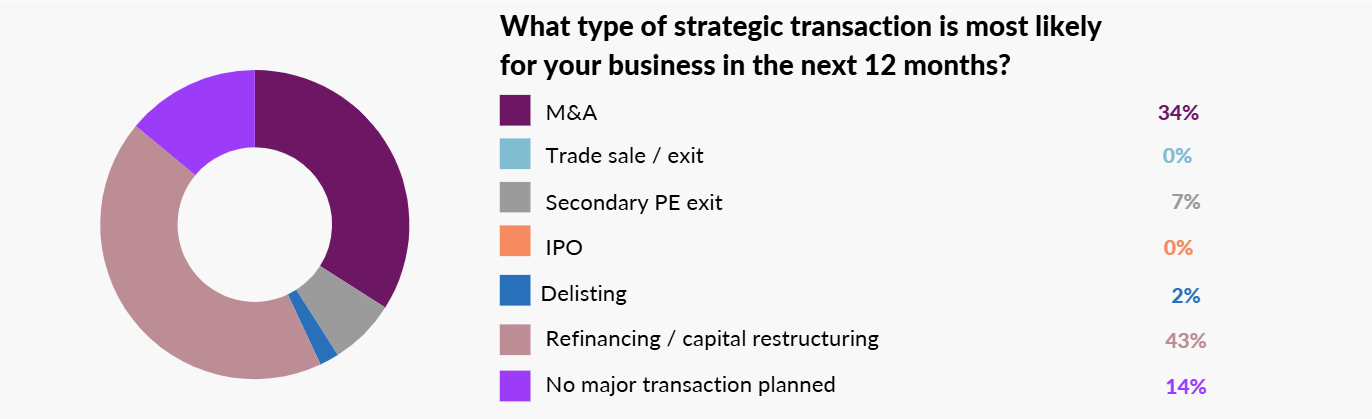 Response taken at Criticaleye's Growth Company Retreat, March 2026
Often in situations where exits are delayed, PE firms will increase their focus on value creation levers, applying extra pressure on leadership teams in the process. Criticaleye CEO
Matthew Blagg flagged this dynamic: “Private equity backers are wanting more information, so the demands have suddenly gone up in terms of information flow at a point when teams are more stretched. So, there's no question at the moment that the competency of leadership will massively drive the outcome.”
In a similar vein, leaders working within listed growth organisations must navigate the expectations of investors, but with the added scrutiny of share price performance.
David Brown, Chair of AIM-listed Renew Holdings and a Board Mentor with Criticaleye, highlighted a paradox in the outlook of investors at present: “Shareholders want the ‘top right-hand corner’ growth … story. But at the same time, they’re saying, ‘At the moment, we'd like lots of certainty, because it's such a scary world. And actually, we would like you to keep the share price where it is. We don't want you to do anything too risky.’”
This opens up an interesting debate around risk and growth, which is a difficult balancing act for companies. David added: “If you're not growing, you're going backwards ... You want to be hitting your targets and meeting the strategic objectives. And you've got to balance that with risk. I don't think you can ever provide certainty, so you’re taking calculated risks all the time.”
Rather than turning away from risk, which might seem the expedient thing to do at present, growth-oriented leadership teams actually face towards it, according to Matthew. “You want risk – that's where the opportunity is,” he said. “Great leaders run towards it. They can qualify it better than the next team. It's just making sure that you can articulate that. Great leaders can take risk and compound it down, and as long as you've got that knowledge around you, everyone benefits.”
Creating the right mix of risk and opportunity to get a company’s growth engine firing requires strong alignment between the shareholders, the Board and the executive. Matthew said: “The reality is that it’s not a perfect world and those things aren’t necessarily aligned at all times. Therefore, the CEO must try and navigate that component and bring all these elements together.”
When it comes to the Board, there is a need for the right level of engagement and trust in the management team, while also providing strategic steer when the Chair and non-executive directors feel that leadership is starting to veer away from the agreed long-term direction of the business.
Jenny Harrison, CFO of enfinium, said “it's enormously valuable when you get that high level of positive support from Board members, and I think that kind of alignment and autonomy is crucial”. She noted how important it is for the leadership team to be seen by the key stakeholders that they are driving operational performance in a way that dovetails with the agreed strategy. “I think it's critical that we demonstrate that we're owning our own future. So, if the pace is too fast, we need to take ownership of that as an executive [team] and work out what we need to change.”
It just goes to show that only the most proactive leadership teams will be able to deliver on the growth strategy, given that the pace and complexity of the operating environment continues to make organic growth and M&A challenging.
As Max said: “High quality management teams are those that are able to communicate a clear equity story and value creation plan, provide clarity on the financials and are capable to execute in this market.”