Culture is no longer solely confined to the realm of HR. Instead, it is recognised as a Board-level priority as it influences performance, risk management and strategy. High-performing Chairs and non-executive directors understand that organisations can move faster and be more resilient when culture and mindset are in the right place.
It’s a topic that was discussed at Criticaleye’s recent Chair & NED Forum. Speakers considered the ways in which Boards shape, debate and evaluate culture from the Boardroom.
Lucinda Charles-Jones, a NED at Aon UK and Board Mentor with Criticaleye, said: “Where I see it done well, the Board has a really strategic, robust, quite pointy debate on culture in the very early stages of strategic planning. Culture isn’t just an enabler of strategy execution, it is also a source of competitive advantage – what does your desired culture need to be to allow you to win in your markets, to beat the competition and to enable long-term sustainable success?”
Neil Hayward, Chair of Applied Monitoring and also a Board Mentor at Criticaleye, made it clear that “no strategy succeeds if the organisational culture doesn't support it, and a culture that's resistant to change and innovation and isn't accountable will undermine execution at every level”.
The trick is for discussions to have clear outcomes. “Boards are legally required to oversee corporate culture anyway under the UK Corporate Governance Code mandate,” Neil clarified. “We're there to ensure ethical decision-making and accountability, so why not make this more than a tick-box exercise? Then the question becomes, as a non-executive or a Board, are you spending enough time on this subject versus everything else that you could spend your time on?
“Are you just snorkelling across the surface looking down into the murky depths, not really seeing very much, but covering quite a lot of ground? Or are you choosing to put on the scuba gear and dive and have a look at the bottom of the ocean floor to see what's really going on? What you inspect, not what you expect, makes the difference at Board level.”
She went on to say: “You have to risk sometimes being the unpopular person, asking the question nobody has asked – and that may upset some people. Challenge the executive team, but as long as you remember you are here to serve the organisation and not individual egos, you can still make the journey.”
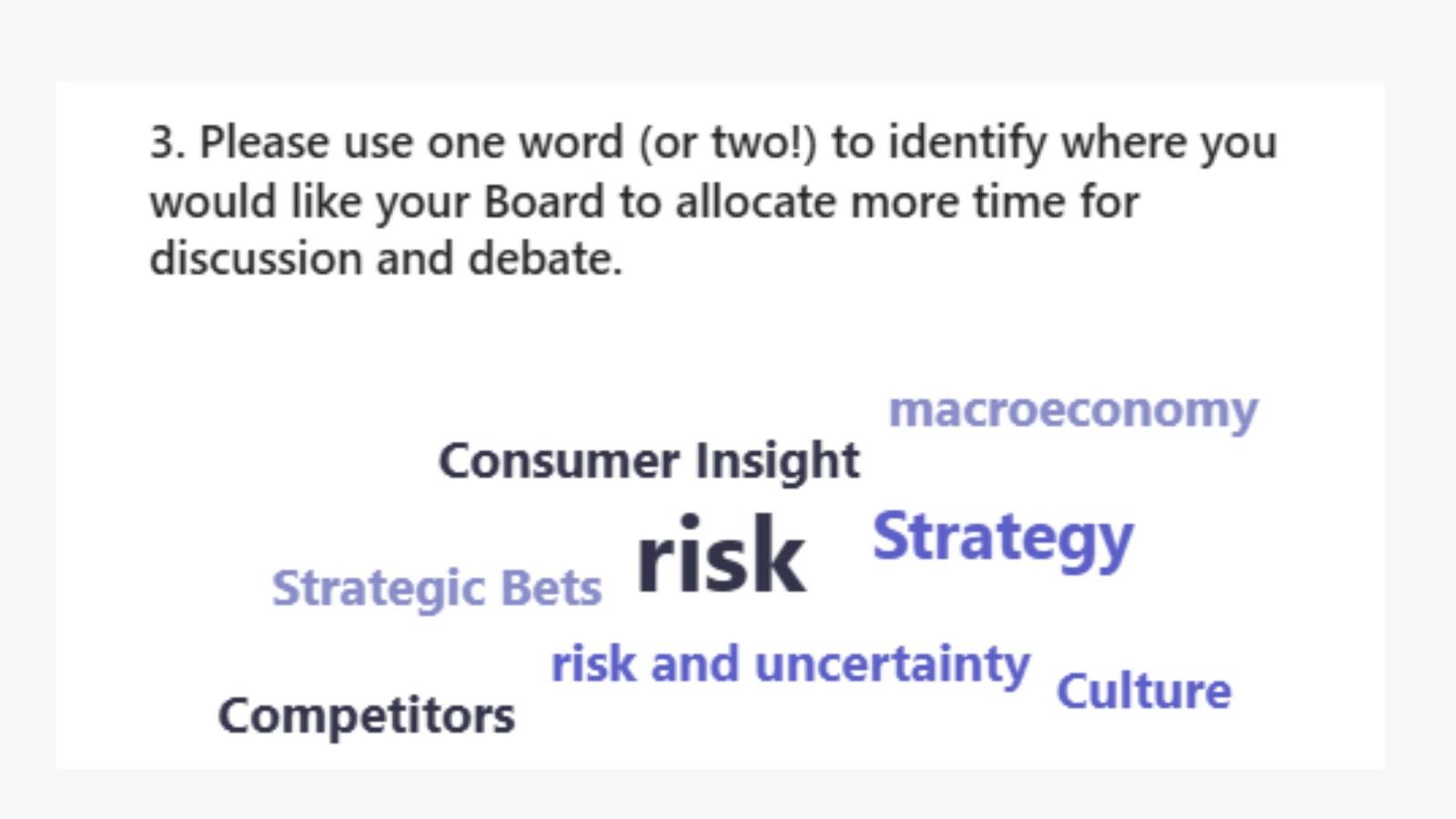
Response taken at Criticaleye's Chair & NED Forum, July 2026
Defence Against Risk
Culture isn’t just the foundation for executing strategy and delivering high performance. It is also the first defence against risk and key to building organisational resilience.
When attendees at the Forum were asked to identify where they would like to have greater time to allocate to discussion and debate in their Boardrooms, the dominant answer was ‘risk’, followed by ‘strategy’ and ‘consumer insights’ (see Word Cloud).
Dominic Emery is Chair of the Board at HutanBio and is a Criticaleye Board Mentor. He said: “One thing that can be done to manage near-term crises and create some cultural alignment is to start to run drills / exercises for those … emergency issues, both with Board members and with executives…
“It's not just about chasing the near term and chasing strategy, it's about the preparedness for these events and running response exercises,” he continued. “That I think is important. Doing that kind of thing starts to cause it to become more embedded as a cultural norm.”
The spectre of potentially crippling AI-enabled cyber-attacks highlights how the risk landscape is accelerating rapidly for businesses, which means that Board leaders must be continuously learning.
This point was not lost on
John Clarke, Chair of UKSBS and Board Mentor at Criticaleye: “I think we do need to raise our game, because the world is changing around us. It's far more dynamic and disruptive than it has been, and the life cycles between those peaks are getting tighter.
“As we move into a less predictable world, with generative AI, agentic AI and other things driving some of that, we have to really step up our own governance around uncomfortable spaces where we don't know the answers, and it tests one's own humility. Being able to say, ‘I will need help here, because I'm not sure if I know enough to be able to apply effective governance’… is very important for the culture.”