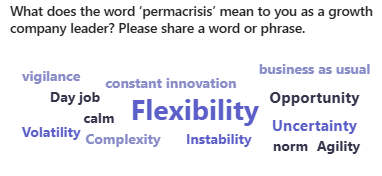
Crisis situations are nothing new for C-suites the world over, whether it’s economic downturn, geopolitical instability or cyber and technology disruption forcing leaders to reconsider the resilience of their businesses. In recent years, however, the gaps between these events seem to be narrowing – or even disappearing – to the point where it feels like business as usual.
This concept of ‘the permacrisis’ was discussed at length during Criticaleye’s recent Growth Company Forum, held in Partnership with
Hitachi Solutions. The Forum gathered executives and non-executives from private equity-backed and listed high-growth organisations to benchmark ideas and best practices relating to building resilient companies in an elevated risk environment.
Rob Gilby has spent 30 years leading businesses across APAC, and is currently CEO of a foundational AI startup called SQREEM Technologies. He said: “One of the roles of leading organisations over the years has been a lot of looking around corners. The strategic planning exercise has become something that's less of an annual event and more of a rolling exercise, constantly trying to find the signal in the noise, because the level of noise in the context that you're operating in is accelerating.”
A key component of strategic planning for leadership teams and Boards is mapping out the evolving risk landscape, but also understanding where it might be possible to drive growth and capitalise on areas where the business might hold a competitive advantage.
Tamsin Todd, Non-executive Director at London-listed Auction Technology Group, described how scenario planning can be a way for companies to capitalise on disruption. “A company might decide that regulation is becoming a much higher risk. But actually, can that be the strategic edge? Can you lean into that and be absolutely the best at operating in a highly regulated market in multiple countries? That could be your strategic moat.
“But to make that shift, what's really important, I find, is that Boards have to have very clear conversations about what their risk appetite is. So once you know that and you've talked about that risk appetite, that's when you can start to plot the organisation’s path through that forest of risk and not get stopped tackling each tree.”
This idea was reinforced by
Sally Bridgeland, who is Chair of the UK home care provider BelleVie Care and a Board Mentor with Criticaleye. She stressed the importance of growth company leaders in particular conducting ‘reverse stress tests’ and asking questions like: “‘What would it take to kill the business?’”
She went on to discuss the ways in which Boards should be supporting the growth ambitions of the business. “It’s less about the backward-looking diligence over papers and making sure we haven't missed anything, and more about how can the Board be a more dynamic critical friend to the business, and work in a complementary way to the chief executive?”
Word cloud taken at Criticaleye's Growth Company Forum, September 2026
AI: Risk and Opportunity
The proliferation of advanced AI models has certainly ratcheted up debates around governance versus innovation within leadership and Board circles. On the one hand, there’s a huge opportunity for the technology to transform entire business models and boost personal productivity. On the other, unconstrained use of AI could introduce potentially catastrophic risk.
Lisa Taillard has been grappling with this conundrum in her role as Director of Change, Adoption and Learning at Hitachi Solutions, where she supports businesses through AI adoption programmes. A recent example involved a pilot study which focused on the introduction of Microsoft Copilot into one team within a client’s business.
She said: “The question wasn't about how do we deploy Copilot? It was how do we help people identify where AI can really improve their work and help them accelerate outcomes?...
“We [also] looked at risk across several layers. First: information and data risk. If we're building agents, what information is that agent actually using or accessing? Is that data current? Is it appropriately accessible? ... AI can make poor content much easier to consume, so permissions and content quality really matter.
“Then it was output risk. Obviously, with AI there is always the chance that the answer is inaccurate, incomplete, or potentially misleading. AI can often pull from different sources just to get an answer and from sensitive areas, particularly around HR, legal and finance. We needed to make sure that the human was remaining accountable for reviewing and approving the output from AI, and that's what we teach throughout the life cycle of the course and why we pilot everything.”
By virtue of leading an AI-driven platform himself, Rob is also seeing an increased focus on governance, whether it relates to data governance, privacy governance or investment in tech stack governance. “I’ve found that the engagement between the executive and Board on how to exercise governance processes has increased.
“But I've also seen organisations freeze from excessive governance because of fear. We've got to take some risks otherwise we don't grow the business. So I'm trying to manage smaller risks and nimbler risks, so that we keep moving forward … and reinvent it as we go along.
“We … [are] trying to create a more agile org that keeps reinventing itself, rather than being a single rigid dimension, because then we’ll miss the opportunity,” he added.
For growth company leaders, striking the right balance between managing a multi-faceted risk landscape and capturing opportunity will be critical not only in building resilient businesses, but to unlocking their next phase of growth.
Jacob Ambrose Willson, Senior Editor, Criticaleye