Powering Up for the Public Markets

Authored by , Senior Editor, Criticaleye
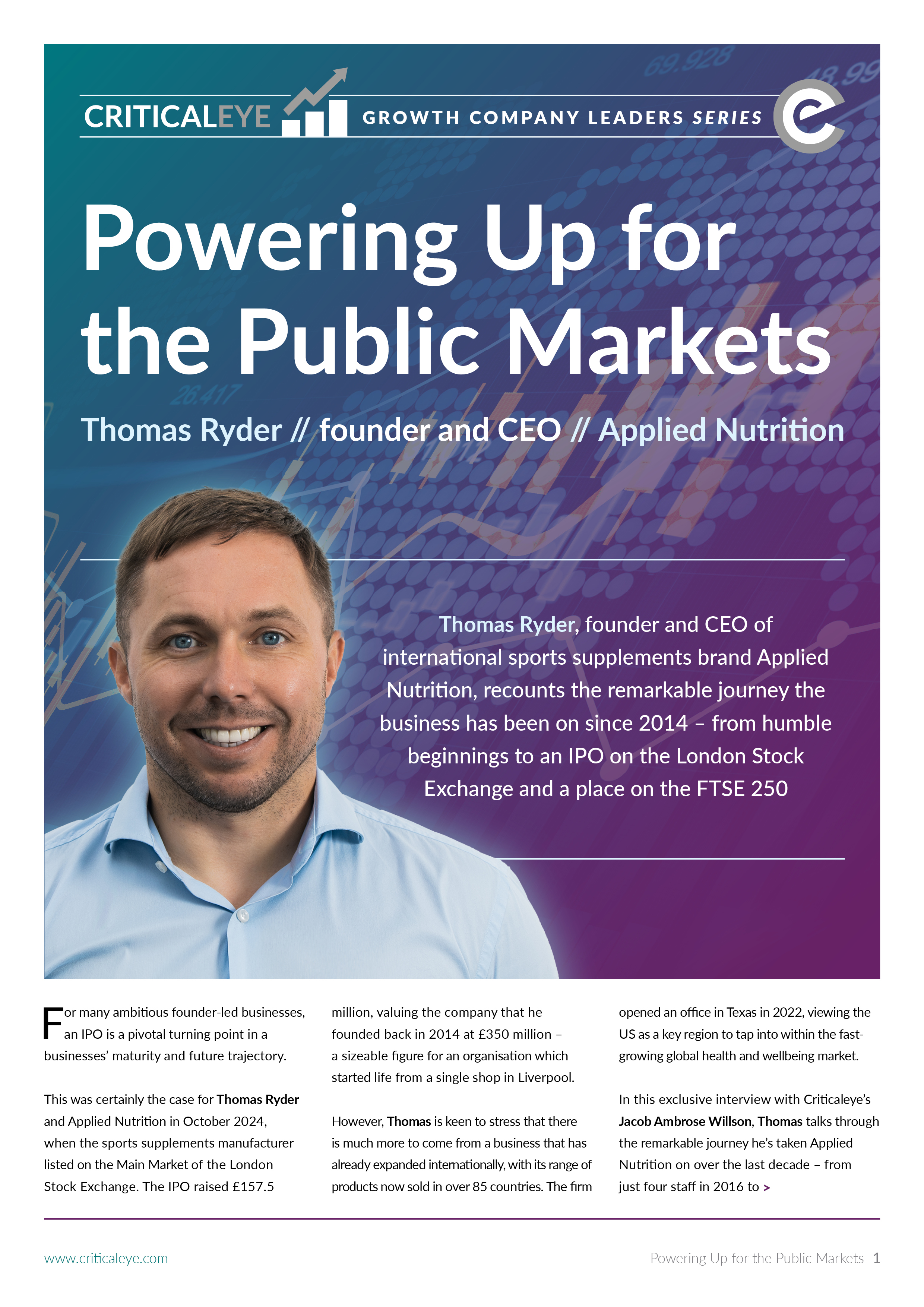
Thomas Ryder, founder and CEO of international sports brand Applied Nutrition, recounts the remarkable journey the business has been on since 2014 – from humble beginnings to an IPO on the London Stock Exchange and a place on the FTSE 250.
For many ambitious founder-led businesses, an IPO is a pivotal turning point in a businesses’ maturity and future trajectory.
This was certainly the case for
Thomas Ryder and Applied Nutrition in October 2024, when the sports supplements manufacturer listed on the Main Market of the London Stock Exchange. The IPO raised £157.5 million, valuing the company that he founded back in 2014 at £350 million – a sizeable figure for an organisation which started life from a single shop in Liverpool.
However, Thomas is keen to stress that there is much more to come from a business that has already expanded internationally, with its range of products now sold in over 85 countries. The firm opened an office in Texas in 2022, viewing the US as a key region to tap into within the fast-growing global health and wellbeing market.
In this exclusive interview with Criticaleye's
Jacob Ambrose Willson,
Thomas talks through the remarkable journey he’s taken Applied Nutrition on over the last decade – from just four staff in 2016 to nearly 300 at present. During this time, the company has delivered consistent profitable growth and recently climbed into the FTSE 250, just 14 months after listing.
JAW: Tell me about the growth journey you’ve been on with Applied Nutrition.
TR: I started the business because I was in the sports nutrition industry and I was selling all the brands. So, when the opportunity came to take over Applied Nutrition in 2014, I took it. At the time, it had one product and I felt that I knew why that product was in decline. I thought I could make some fundamental changes and turn the trajectory of the business around.
I made those changes and the business started growing a little bit. And then in early 2016 I brought production in-house because the manufacturer informed me that my cost of goods was going to increase. I brought consultants on board who showed me how to do it. I started off by building a small room within the warehouse that I was operating from at the time and took on my very first four employees – three of them are still with the business today – and got some training and brought in some food credentials. So we did it properly, even though it was a tiny scale with second-hand equipment and it started from there.
Once we felt we understood how to produce products, we started to scale up the manufacturing. I was calling the landlord every other month saying, ‘Can we knock through and take another warehouse?’ What started off with two small warehouses ended up with 11 big ones.
As we made a bit of money, we invested some more in manufacturing kit. That allowed us to bring more products to market, which allowed us to expand into more countries. And that's the growth journey that we've been on.
JAW: Growth trajectories are never linear though. What challenges have you faced during the last decade?
TR: We’ve faced every single problem you could think of, from Covid to the Red Sea crisis. We import every last raw ingredient and every single bit of packaging from manufacturers, whether it's China, India, or Europe. When container prices went from $2,000 to $20,000, that was a real killer.
We've seen headwinds with whey protein, which is very volatile and currently at the highest price it's ever been. Creatine went from $3 a kilo to $25 a kilo, if you could get your hands on it. But you're not the only person in that boat – that's what I always say to our team. Every brand is facing it, it’s just learning how to navigate it better than anybody else, which we believe we are well-placed to do. And I think that's the mentality we've always had, regardless of any headwinds or potential issues or brick walls that get put up in front of us.
JAW: So, at what point did you realise the business was ready to go public and become a Plc?
TR: I brought in our current COO Steve Granite in 2020 because I knew where we could take the brand, but I just didn't know how to grow as a corporate and Steve did. I felt Steve was the right person to come in and assist me with that. And he was – he was absolutely crucial. At the time we sold some shares to JD Sports [in 2021], we were speaking to private equity. We never ran a process, but we engaged Grant Thornton to engage with a couple of private equity houses to see if there was any interest, and three of them made offers, which was absolutely humbling. Ultimately, we’d done a deal with JD anyway, which never came through private equity.
But we said that for the next transaction, we'd like to see an IPO. At that time, I didn't even know what a Plc was, or an IPO. I just knew that it was the pinnacle, and you’re seen within a different league once you enter the stock market, from a respectability perspective. It just gives you that credibility.
So as we were getting to late 2023, we said, ‘Okay, let's start looking at what our options are.’ So we went out and spoke to a couple of CEOs of Plcs at the time. We had a relationship with Peter Cowgill [now a NED with the business]. We spoke with Andy Bell [now the Chair]. We spoke to a few others and had some negative feedback, some great feedback and we ultimately decided, ‘Okay, we want to become a Plc on the London Stock Exchange, and that's the road that we're going to take.’ So we put our heads down and thank God, in October 2024, we IPO’d.
JAW: How did you find the IPO process?
TR: The process is intense. I'm not going to pretend it's not. It's very, very intense, because you’re trying to run a company at the same time. And it's all credit to our CFO [Joe Pollard]. He took the brunt of it and carried all the heavy weight. And we had a great Board as well. We were building up the Board at that time. We had Tony Buffin. Andy Bell came and joined the Board. We had some good people.
JAW: Marnie Millard too? She is a Board Mentor with us at Criticaleye.
TR: She joined us pre-IPO. Marnie was crucial and still is today. And I think we put a good team together that were well experienced within Plc worlds, and we just had to do what we had to do. We had to go to our meetings; constantly meeting new investors; tweaking your decks; learning more about our business.
The more questions you get asked by investors, the more you have to come back and say, ‘Okay, how do I articulate this answer in a clearer way because I know my business, but they don't, so how do I communicate it to them?’ So we felt that by just being able to answer questions more clearly, we found out a lot more about our business, which helped us a lot.
JAW: Many leaders of listed businesses feel their share price doesn’t reflect performance. Is that a challenge you’ve faced?
TR: Honestly, I had sleepless nights over it. When we first IPO’d, we took a bit of a dip in the share price. People have backed you, people [have] invested into you and the share price goes down. But it's nothing that you've done, because you're doing everything that you need to do.
I learned quickly from an early stage to stop looking at the share price. You just keep doing what you should do, and the share price will look after itself. Now, I don't even look at it. And I just continue to deliver. Work hard. Do what you need to do. Thankfully, the share price is now seeing a positive reflection. But there were moments where I was absolutely devastated. I felt like I was letting people down because the share price dropped for no reason.
JAW: What are the next steps now for the business?
TR: We've grown a lot, but we haven't scratched the surface of what we could do. If you look at some of our competitors, they're doing a billion pounds worth of sales. 70 percent of those sales are on one product. We closed up last year £107 million [in revenue] and we're far more diverse. We play in far more categories, far more areas. We appeal to far more consumers. To support our growth, we have started to further invest in our production capacity so we can continue to expand in line with the opportunity ahead of us.
So, we've got a lot more growth to go after in all existing markets, all existing channels. And yes, we do want to expand into more geographies, we do want to expand into more channels and we do want to get deeper distribution in existing channels. It really is an exciting time for the business.
A reflection of sports nutrition, health and wellness becoming more mainstream is that in December [2025] we were delighted to announce an agreement with Morrisons for a range of Applied Nutrition branded meals and products, and we are pleased to be working with Morrisons to provide high-protein food choices on supermarket shelves.
JAW: Reflecting on the last 10 years, what elements of the journey have you personally found most difficult, and most rewarding?
TR: We're about 300 staff now, including an office in the US, so I think just scaling the team in all departments has probably been naturally the most challenging. But again, we've got a good team that's handled that and we've done it really well.
The most rewarding thing is enjoying wins together with the team. Every little win we celebrate. I think that's important. To celebrate a win with somebody, whether it's someone in the warehouse, someone in production, the sales guys, I think it's rewarding to see people feel like they've achieved something.
And when we IPO’d, you walk around our business and everybody's got such a beam of pride on their faces because they know that without them, it couldn't ever have happened, and it really couldn't.

[33].jpg)

 Displaying 1 to 3 of 21
 (002).png "Palo Alto Networks")