Building an AI-Ready Workforce

Authored by , Editorial Intern, Criticaleye
AI is reshaping ways of working faster than most organisations can adapt, putting talent strategy at the top of the Board agenda. Criticaleye's Anna Mitchell asks Board Leaders and CPOs with hands-on experience of the technology what it takes to build an AI-ready workforce.
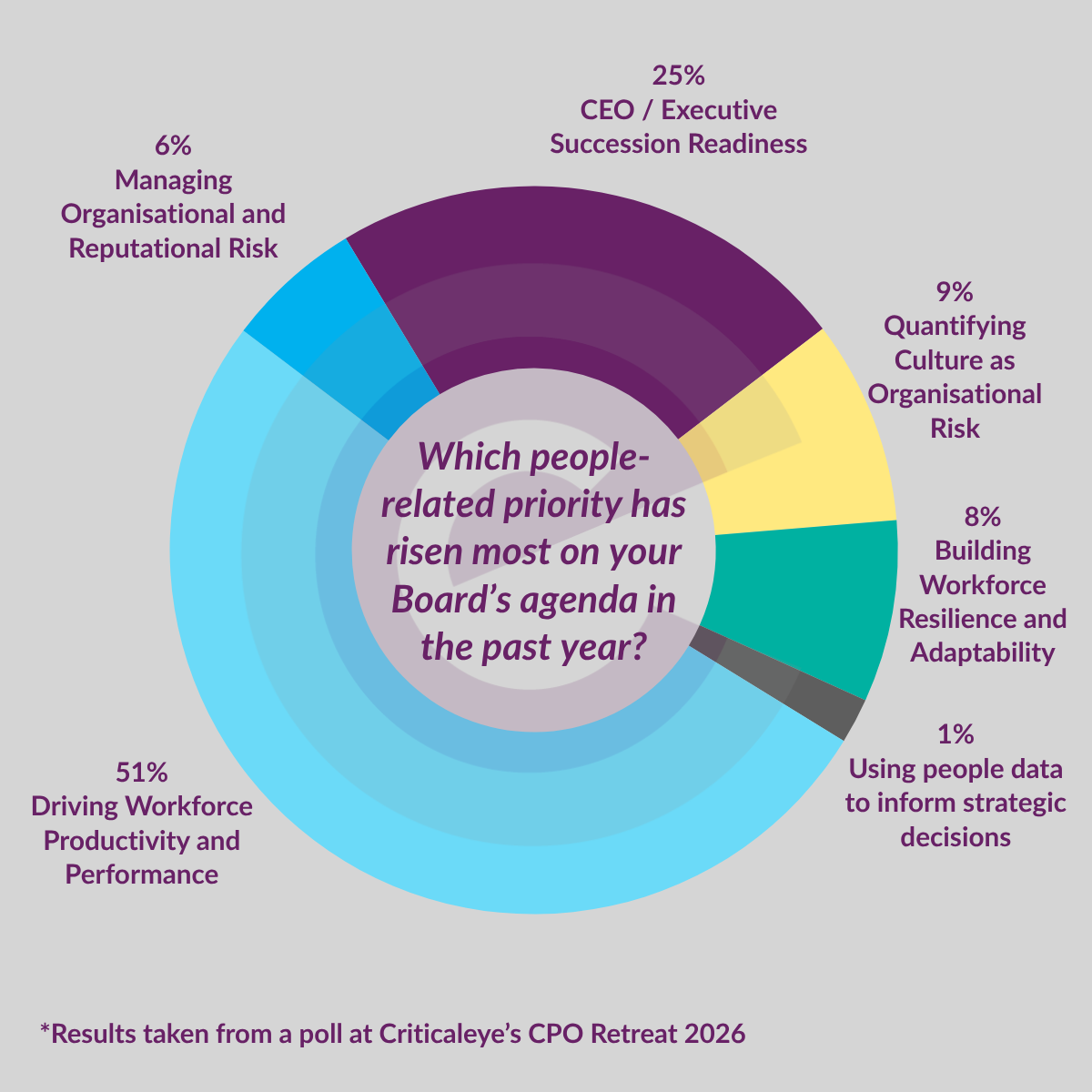
As artificial intelligence (AI) advances, it is fundamentally transforming how organisations operate around the globe. CEOs [71 percent] ranked new technology, including AI and machine learning, as their top priority for the next 12 months, according to a survey taken at Criticaleye’s 2026 CEO Retreat. In a similar vein, 51 percent of CPOs said driving workforce productivity and performance has risen most on the Board’s agenda in the past year, in a poll taken at Criticaleye’s 2026 CPO Retreat.
That gap between ambition and execution is already testing leaders, who must navigate AI adoption both tactically and strategically. Organisations are increasingly turning to AI to drive innovation and efficiency, and by automating repetitive, data-intensive tasks, the technology is freeing employees to focus on higher-value work.
Yet the rapid expansion of AI raises important questions about implementation, reskilling and organisational redesign. Chairs, Board leaders and CPOs alike must strike a balance between embracing the technology to get ahead and establishing guardrails to maintain organisational integrity and manage risk.
A Leadership Perspective on AI Implementation
Strategic, responsible implementation is key to closing the gap between AI's promise and its delivery — and that starts with how leaders themselves think about the technology.
Devyani Vaishampayan, RemCo Chair and Non-executive Director at NHS Supply Chain Coordination and Criticaleye Board Mentor, isn’t new to the evolving world of AI. She left the corporate world to pursue a career as an AI entrepreneur around ten years ago.
"We are no longer talking about using technology for automating existing processes," Devyani says. "AI is being used to reimagine processes, replace white collar tasks and offer predictive insights. The more organisations realise this, and look at replicating AI for reimagining work, that's when the major benefits to productivity are going to happen."
Tom Darby, CPO of enfinium, has first-hand experience of deploying AI in the workforce. With a dual mandate as CTO and CPO, he says the emerging technology was a key driver in his transition to the people role.
Tom says enfinium, one of the UK's largest energy-from-waste operators, is planning facilitated organisation-wide exercises in which employees are given an hour to explore how to problem-solve using AI, demonstrating the balance between an established framework and encouraged innovation, which he argues is essential for growth.
"How do you track, and how do you encourage, but control it in a way that doesn't squash innovation, but still gives you some semblance of governance over what's happening in your IT environment?" Tom asks.
He believes in leading by example: "I'm not one that goes 'do as I say' rather than 'do as I do.' I want people to believe and embrace this stuff, because if they don't embrace it, then they reject it."
Nicola Hodson, Chair of IBM UK and Ireland, takes a similar view. "The technology comes quick and fast, and so your role can be to adopt the technology to get the maximum out of it," she explains. "That means setting an example in terms of the way you use it yourself, encouraging your team to use it, finding ways to give feedback if it isn't quite working the way it's anticipated, and then just pushing the boundaries."
The AI ‘Talent Challenge’
Employers remain uncertain about the breadth of impact that AI will have on hiring and employment when the dust settles. In an attempt to evaluate future workforce needs as to not overemploy, hiring remains tepid.
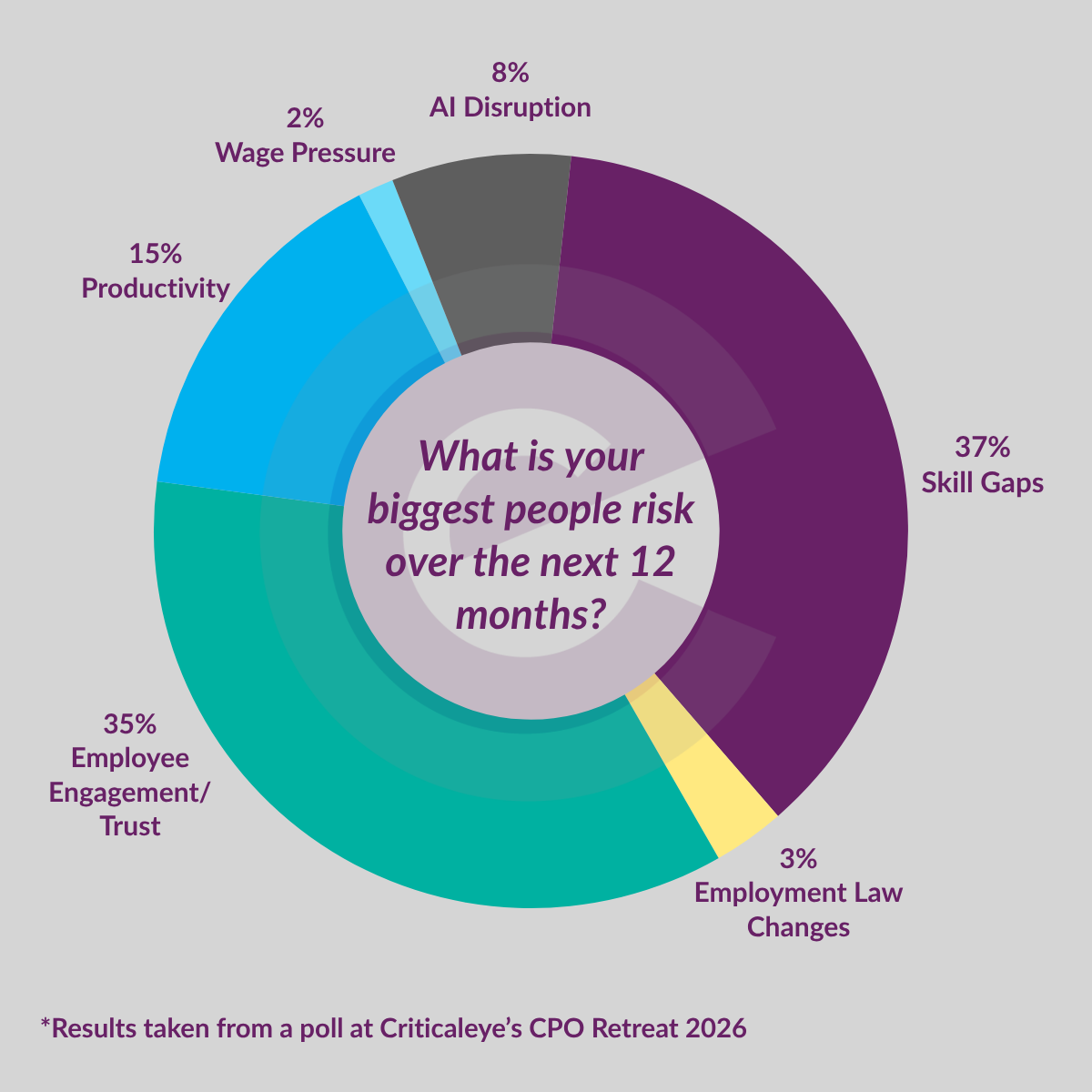
The scale of the concern is clear, as seen in a poll taken at the CPO Retreat: asked about the biggest risk to their workforce, 37 percent of CPOs pointed to skills gaps, with a further 35 percent citing employee engagement and trust — underlining the need to build and retain skills simultaneously.
Industry leaders must now ask this critical question: To build the strongest, most AI literate workforce, is it better to upskill current employees or hire proficient talent from the outside?
"The number one priority for organisations, when it comes to getting workforces ready for AI, is upskilling," Devyani asserts. "Upskilling starts with basic knowledge of AI, the use of agentic AI and creating a culture of agility and learning."
"Everyone needs AI talent, and it's very scarce," she says. "So there's no way you can just rely on hiring from the outside. You have to use the strategy of 'build' and not just 'buy.'"
The challenge is not confined to junior levels of the workforce, she warns. "This gap is a risk, because you have younger people who are quite AI literate, who are eager to use it, but you have middle management who don't get it... The big imperative for managers and leaders is they become AI literate themselves and start using AI for practical things."
Tom maintains that internal reskilling is essential but should go in tandem with smart external hires:
“The way to manage that tension between having a workforce that potentially doesn't have the skills, is to bring people in, essentially balancing the number of people who are already using it [AI] and bringing it in, as well as recruiting for different behaviours and skills rather than technologies,” he says.
Much of reskilling revolves around teaching employees how best to use AI as it evolves, as opposed to training them through repetition or completion of tasks.
Building on this, Nicola says: "It then means you've got to train people in a different way, because you're not training them by doing all of those tasks themselves anymore, you're training them by helping them walk through the line of judgement and how to think about the information and how to build their skills and critical thinking on top of it."
Devyani echoes the point, cautioning that over-reliance on the technology carries its own dangers. "What AI can do is make us lazy, because you rely on instant information and analysis which may not be accurate," she says. "You forget to then apply your mind, you forget to think. Hence, the emphasis on critical thinking and judgement becomes even more important."
AI will never replace the need for human reasoning in the workplace, Nicola adds. "There are things where judgement is really important. AI can do a lot of the background work and the data crunching to help the leaders and managers, but it still doesn't take over the judgement that is required at the end of the day."
The Start of Organisational Redesign
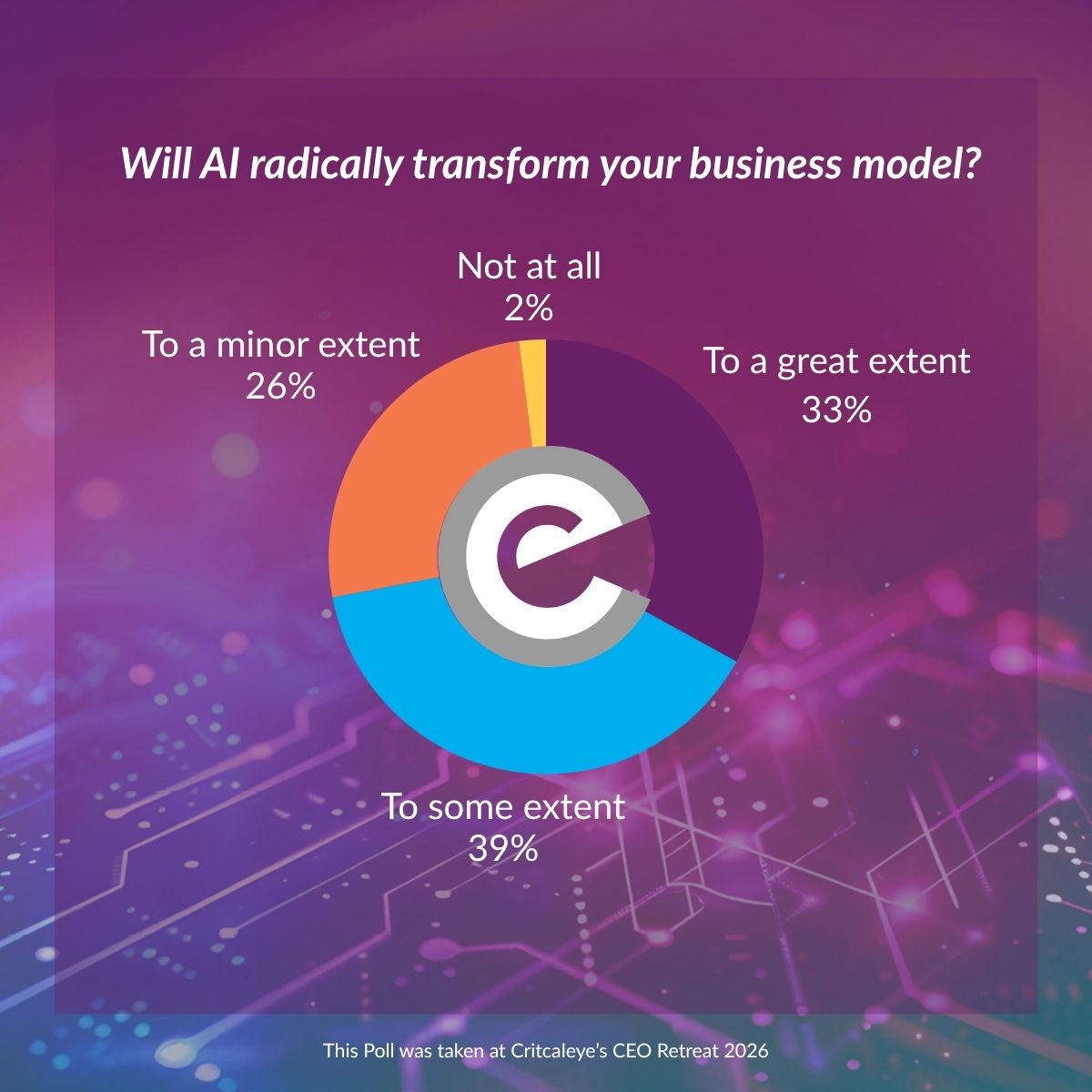
AI continues to get smarter, driving the need for streamlined decision-making and, in many cases, organisational redesign. Indeed, the overwhelming majority [72 percent] of CEOs agreed that AI will radically transform business models, according to a poll taken at the CEO Retreat.
Leaders, such as Nicola, are prioritising a revamped structure and decision-making process as AI continues to influence ways of working.
"AI is now being looked at much more as to how do I challenge the way my business operates, how do I rewire it, how do I rethink my processes and design them for an era where I'll have people working alongside AI agents? And that means a whole rethink," she says. "It means different decision processes."
"You're not just bringing in new technology, you are driving an organisational change," Nicola adds. "And that means it's not going to happen if people aren't on board with it, and they only get on board with it if they can see there's something in it for them and they're not afraid of what's coming, and they see some positives."
The pace of change makes clarity and strong leadership even more vital. "AI is moving faster than businesses can absorb it," Nicola continues. "As you redesign all these workflows, you have to redesign the decision points. If there's any ambiguity, it's going to cause a problem. If you're doing things ten times faster, it's going to expose the problem ten times sooner."
There is no sign yet of the AI boom slowing down, so management teams and Boards must decide how to navigate a future for the workforce that remains unclear.
From a CPO perspective, Tom is hesitant to predict how exactly AI will reshape the workplace, though the potential value of the technology is a great source of excitement. "It's really difficult to do that prediction bit," he explains. "All you can really say is, 'Well, actually, what are the business challenges we've got in front of us, and how can we apply the relevant technology to them and then how can we get the technology to shift as we're going along to improve it?'"
To Devyani, that uncertainty is precisely why adaptability matters more than prediction. "You can't plan too much for the future," she concludes. "Therefore, you have to have a talent ecosystem that empowers people to take charge of their own development and careers."

.jpg)
.png)
 Nicola Hodson
 Tom Darby
 Displaying 1 to 3 of 258